
Running a Sex Offender Check in Covington County
The Alabama Law Enforcement Agency CJIS Sex Offender Registry Unit maintains the statewide registry. Local law enforcement registers covered people and transmits updates, current photographs, and fingerprints. For Covington County residents, the Sheriff's Office is the local registration and reporting contact. ALEA says its public system updates daily in real time from local submissions, so the quality of the state entry still depends on local reporting.
Use the official registry by name or place, then compare enough public fields to avoid a mistaken match. A county or ZIP search helps with local awareness. A geographic search can help around a specific area. The official Covington County Sheriff AL app also references a sex-offender function, but its exact search fields and alert behavior were not verified. The state registry remains the documented public search source.
Official Covington County Registry Search
ALEA's public registry is the correct Alabama source, not a commercial data broker. Ala. Code § 15-20A-8 requires public search modes by name, city or town, county, ZIP code, and geographic radius. JavaScript and anti-bot controls prevented a full live inspection, so exact radius choices, button labels, map toggles, and sorting are not assumed.
A county filter and a geographic search answer different questions. Selecting Covington County collects matching county entries under the live state system. An address and radius search focuses on a point and the distance options ALEA currently offers. Florala's border setting can also make an Alabama-only radius incomplete for nearby Florida locations, which is why the national participating-jurisdiction layer belongs later in the search.
The official ALEA Sex Offender Registry search presents the state form.
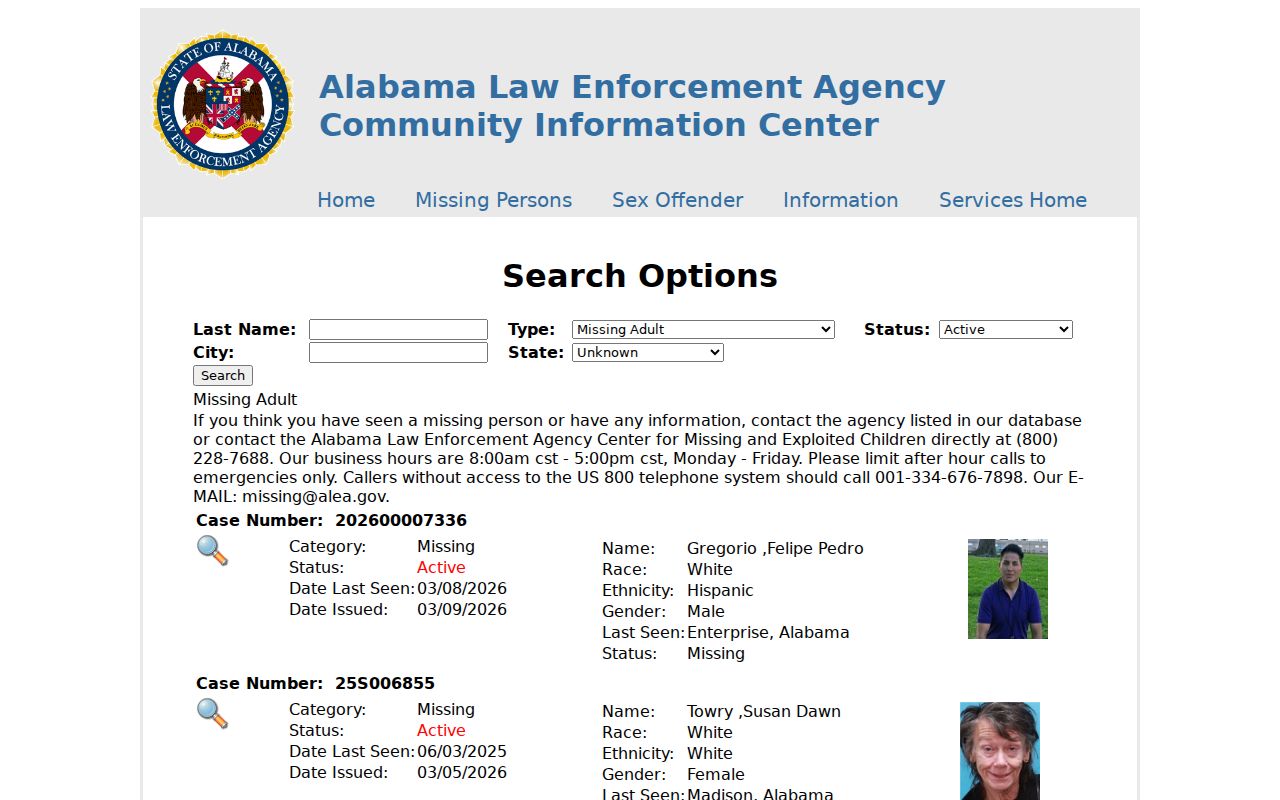
This state-owned interface is the primary place to filter Alabama registry entries to Covington County.
Searching the Alabama Sex Offender Registry
Begin with the narrowest accurate information available. Name searches can find a known person, while county, city, ZIP, and radius modes answer area-based safety questions. Because the current interface details can change, use the labels shown on the live ALEA form and do not assume wildcard behavior.
- Open the official ALEA registry and read its conditions and warning.
- Search by name, or choose Covington County, a city or town, ZIP code, or a geographic radius.
- Review the result list and compare public identity and location details rather than relying on one field.
- Open the profile to read the qualifying offense, registration status, and public locations.
- Report a suspected wrong address or noncompliance concern to the Covington County Sheriff's Office.
| Search concept | Control type | Required status | Verified note |
|---|---|---|---|
| Name | Text | One available search mode | Exact name components and wildcard rules were not verified |
| City or town | Text or selector | One available search mode | Required by Ala. Code § 15-20A-8 |
| County | Selector | One available search mode | Select Covington from Alabama counties |
| ZIP code | Text | One available search mode | Statutorily supported |
| Geographic radius | Address and radius controls | One available search mode | Exact distance options were not verified |
Covington County Registry Public Data
The public registry shows less than the full law-enforcement registration record. Public material generally includes a name and aliases, photograph and physical description, residence, work or school locations, vehicles, qualifying offense and conviction facts, court data, and compliance or absconder status.
Alabama Administrative Rule 760-X-3-.03 requires local registration to collect a broader set. It can include identity numbers, temporary lodging, household facts, occupational details, relative contacts, vehicle identifiers, electronic contacts, prints, DNA status, licenses, offense details, supervision, warrants, and compliance events. Many of those fields are not public. Social Security numbers, victim identities, travel-document numbers, email or instant-message identifiers, and internet-service data are among the items excluded from public display.
This public and nonpublic split matters when a profile seems sparse. The state page is not meant to reproduce the sheriff's complete registration file. It publishes the fields Alabama designates for notice and withholds protected details. A request for information outside the public profile should be directed to the official custodian, which can explain whether the field is nonpublic, not collected for that record, or simply not part of the web display.
The ALEA Community Information Center is the broader official public-information entry point.
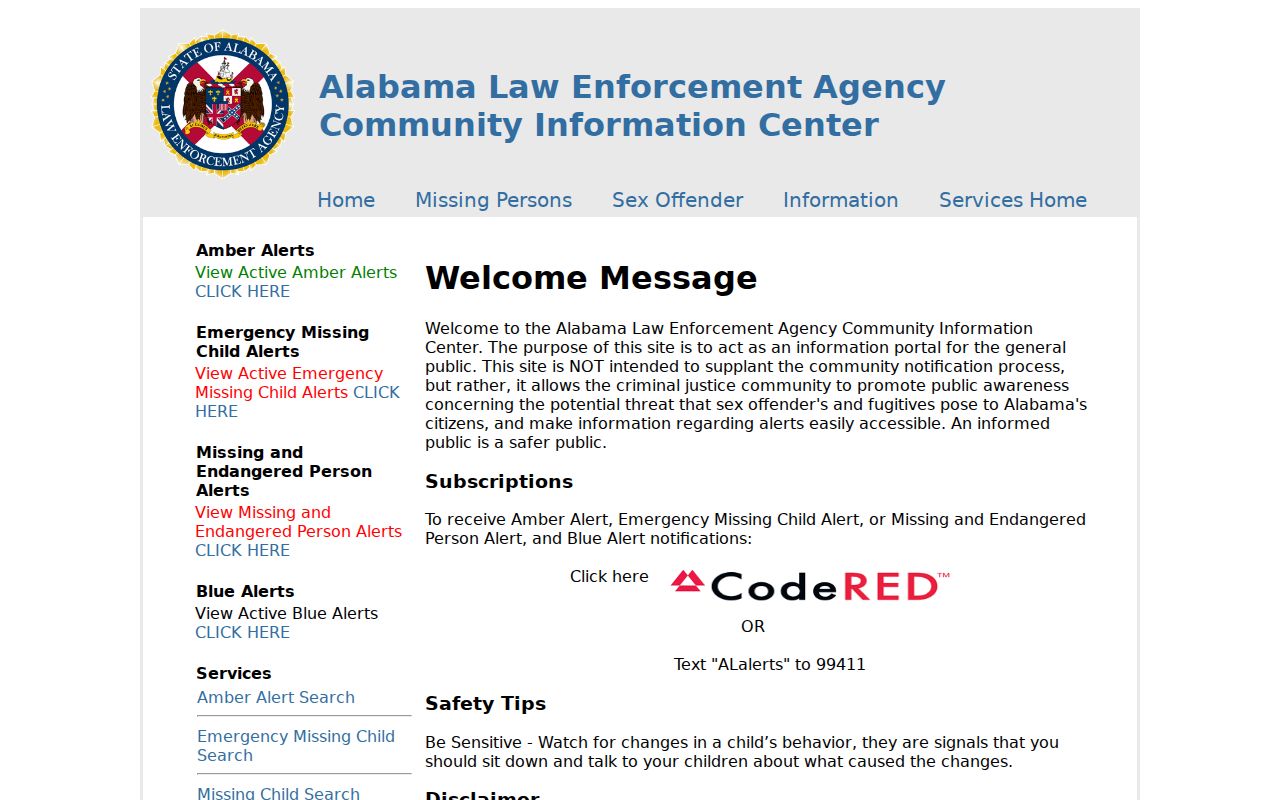
The portal context helps separate public safety information from nonpublic registration data.
What a Registry Profile Shows
Read the whole Covington County registry profile before drawing a conclusion. A photo and name can help identify the listed person, but status, offense, court, and reported location explain why the entry appears and whether ALEA marks a compliance issue.
| Name and aliases | Public identity names tied to the registry entry. |
|---|---|
| Photo and description | Current submitted photograph and public physical traits. |
| Reported locations | Public residence plus work or school locations where applicable. |
| Vehicles | Public vehicle details associated with the registration record. |
| Qualifying offense | Conviction, jurisdiction, court, and covered offense information. |
| Registration status | Compliance, absconder, custody, or other public status indicators. |
A public profile does not list nonconviction arrests. It also does not expose every item local law enforcement collects. That difference protects restricted information while providing the fields Alabama law selects for community notification.
Missing Covington County Registry Profiles
Not every sexual-offense conviction creates a public ALEA profile. Juvenile and youthful-offender matters can follow different public-access rules. ALEA also identifies limits involving a first offense of Indecent Exposure or Sexual Misconduct and some out-of-state, federal, or military cases that may require a due-process hearing.
A missing search result therefore does not prove the absence of any conviction. It may reflect legal dissemination limits, different registration treatment, a spelling or location mismatch, or a record still moving through the local-to-state update chain. Court files answer what happened in a prosecution, while the registry answers which covered information Alabama currently publishes.
The official ALEA registry FAQ explains public-listing limits, update timing, and verification rules.
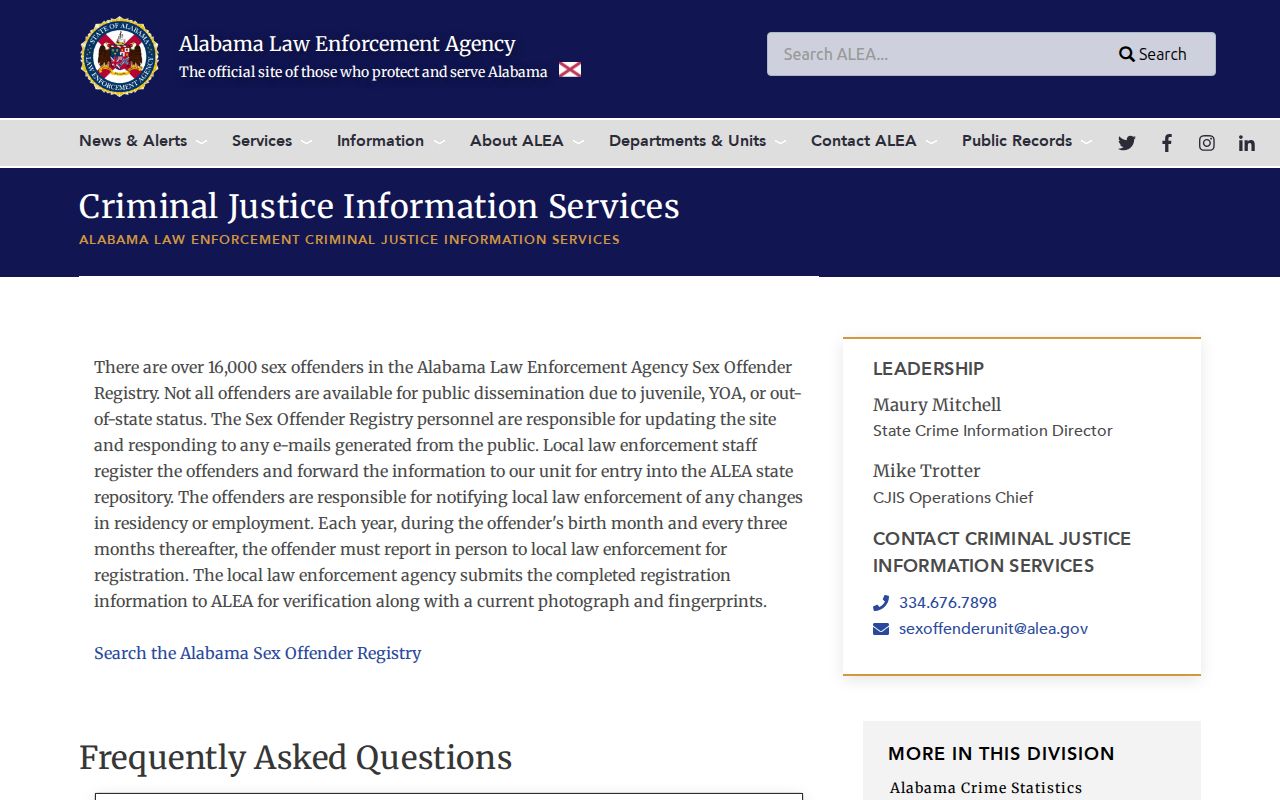
Those limits are why a registry check and a court-case check should not be treated as the same search.
Registration Requirements and Levels in Alabama
Alabama does not place adult registrants into a simple public Tier I, Tier II, and Tier III duration table. Adult covered offenders generally register for life and verify in person during the birth month and every three months after that. Juvenile rules use age, covered offense, and risk findings to determine duration and public visibility.
| Alabama category | Duration | Visibility or verification |
|---|---|---|
| Adult covered offender | Generally lifetime | Birth month and every three months thereafter |
| Juvenile age 14+ with a listed severe § 15-20A-28(a) offense | Lifetime, with possible petition after 25 years | Public treatment under the governing provisions |
| Other covered juvenile | 10 years from first registration | Risk level controls notice |
| Low-risk juvenile | Applicable juvenile duration | Confidential, school-specific notice |
| Moderate-risk juvenile | Applicable juvenile duration | Notice to schools and childcare within three miles |
| High-risk juvenile | Applicable juvenile duration | Public notice comparable to the adult process |
These categories describe registration and notice. They should not be replaced with a three-tier adult chart that Alabama does not use.
Covington County Registry Residence Rule
Ala. Code § 15-20A-11 generally bars an adult covered offender from establishing a residence within 2,000 feet of a school, childcare facility, or resident camp. The distance is measured from property line to property line. Victim-related distance rules can also apply. Written preapproval by local law enforcement has legal importance, so a map estimate alone should not be treated as an official location decision.
For a Covington County address question, contact the Sheriff's Office before relying on a consumer map or rough measurement. The local office can address its registration role, while ALEA maintains the state public entry. The statute is detailed, and the facts of a site can matter.
If a public address appears wrong, note the profile, reported location, and date of the observation. Contact the Covington County Sheriff's Office rather than attempting personal verification. The sheriff can compare the report with information held for local registration and send an update through the proper channel. ALEA's Sex Offender Unit provides a second official route when the concern involves the statewide display or a question about registry administration.
Note: A public registry map supports awareness, but it does not replace written local-law-enforcement review where Alabama law calls for it.
Covington County Registry and NSOPW
Covington County reaches the Florida line at Florala, making a cross-state layer useful. ALEA provides Alabama-specific entries and state status details. The U.S. Department of Justice National Sex Offender Public Website, or NSOPW, searches participating jurisdictions across state lines. It can broaden an area search, but participating source records still control their own content and updates.
The official NSOPW search supplies that national layer.
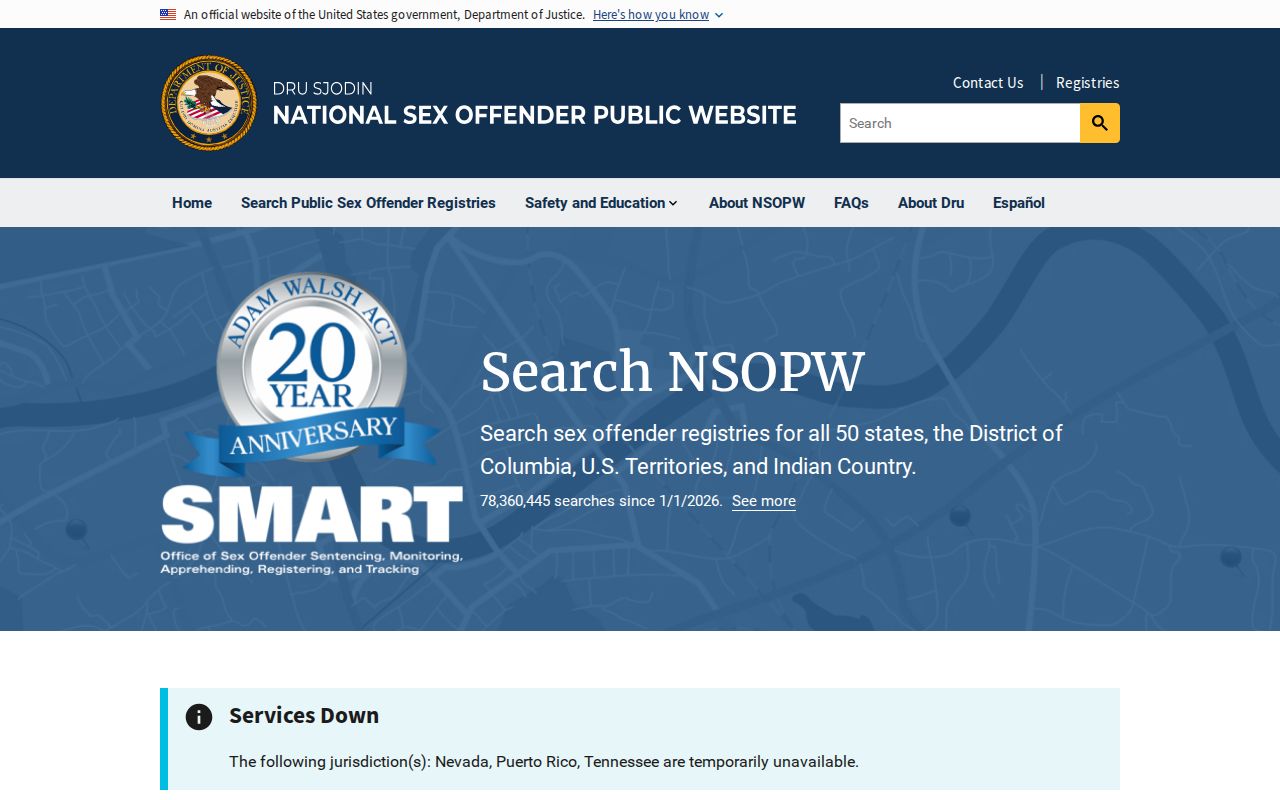
For an Alabama match, return to ALEA and the Covington County Sheriff's Office for the state and local context.
Lawful Use and Community Notification
Registry information exists for public awareness and safety planning. If an address appears wrong or a person may not be complying, report the concern rather than confronting anyone. The Covington County Sheriff's Office is at 260 Hillcrest Drive in Andalusia and can be reached at 334-428-2641. The ALEA Sex Offender Unit can be reached at 334-676-7898 or sexoffenderunit@alea.gov.
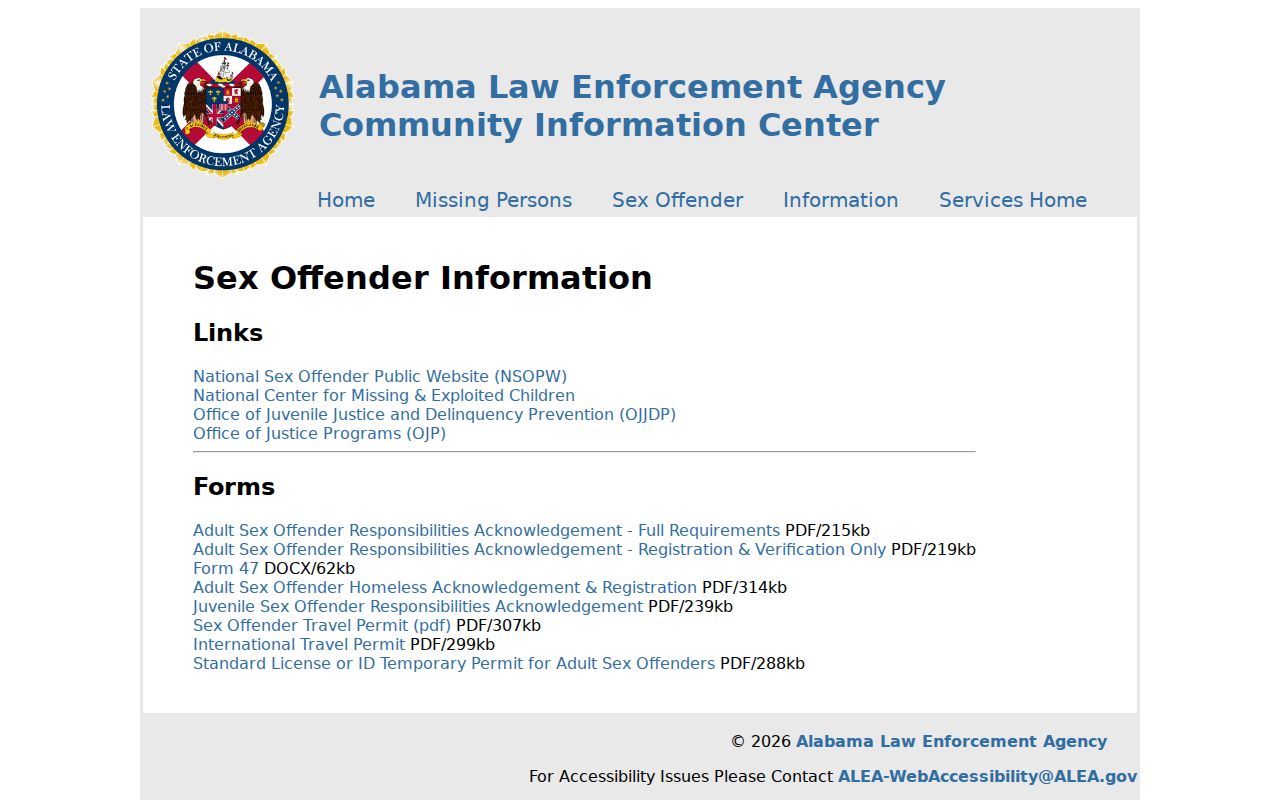
ALEA also publishes official registry forms and federal registry links.
Those official contacts provide a reporting route when a public profile needs agency review.
Misuse is unlawful: Ala. Code § 15-20A-8 warns that registry information may not be used to injure, harass, or commit a crime against a listed person or anyone at a reported residence or work address. Civil or criminal penalties may result.